
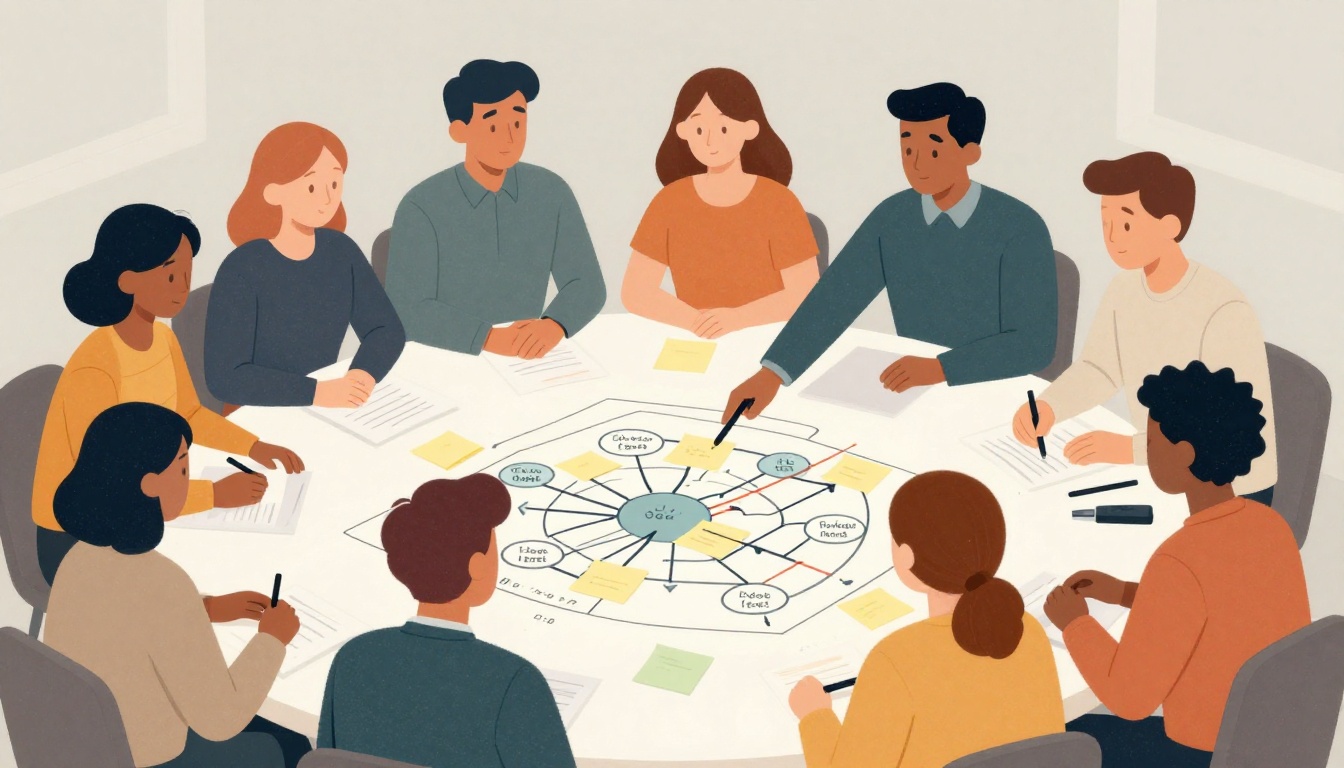
Process discovery workshops often fail not because of a lack of effort, but because they lack structure. You gather a room of busy stakeholders, put a blank whiteboard in front of them, and ask, "How does this process work?" The result is usually a mix of vague opinions, silent disagreements, and a map that reflects how things are supposed to work—not how they actually do. To run a workshop that produces a reliable current-state map and genuine improvement opportunities, you need a deliberate approach: clear objectives, the right participants, and facilitation techniques that make scale and variation explicit.
Which of the following is a recommended practice for process discovery workshops?
Select one answer.
Before the workshop: set the stage for success
Preparation is the single biggest predictor of workshop quality. Start by establishing a clear objective. Determine whether you are mapping an entire functional process or focusing on a specific aspect, and share a detailed agenda with participants so they know what to expect (source: LinkedIn article on online process discovery workshops). Gather any existing documentation—SOPs, process maps, or system guides—and consider conducting a pre-workshop analysis to draft a preliminary process map. This draft becomes a starting point for validation, rather than asking stakeholders to start from a blank canvas (source: LinkedIn article on online process discovery workshops).
Clarify process jargon in advance. Terms like "business process," "work instructions," "roles," and "procedures" can mean different things to different people. Aligning on definitions before the session prevents confusion and keeps the conversation focused (source: LinkedIn article on online process discovery workshops).
Who should be in the room
Who is present at your discovery session has a major effect on what you learn. Pick the wrong people and you may end up misinformed (source: Mural blog on discovery sessions). Invite a diverse group: those directly involved in the process, plus stakeholders who benefit from its outcomes. This ensures a comprehensive view and a variety of perspectives (source: LinkedIn article on online process discovery workshops). If scheduling conflicts prevent all stakeholders from attending, meet with functional area experts individually for 1 to 1.5-hour sessions, then bring everyone together for a consolidated review (source: LinkedIn article on online process discovery workshops).
Facilitation techniques that uncover the real process
Manual process discovery techniques rely on people's knowledge of how a process works, but their perceptions tend to be subjective and are often inaccurate. Therefore, manual techniques should never be used in isolation—they should always be paired with data-based techniques (source: Celonis blog on process discovery methods). During the workshop, use structured activities that draw out specifics rather than open-ended discussion.
One of the most effective techniques is to make scale explicit. Ask questions like: "How often does this happen?", "How many people perform this role?", and "How long does it take?" These questions surface implicit assumptions and can reveal that the scale isn't actually understood—for example, "We don't actually know how many customers abandon their cart!" (source: Medium article on domain discovery facilitation). This insight alone can redirect the entire improvement effort.
Another technique is to explore how the system has evolved into its current state and how it is likely to evolve in the future. This helps participants see the process as dynamic, not static, and can highlight why certain steps exist (source: Medium article on domain discovery facilitation).
A practical workshop flow
Follow this sequence to keep the session productive:
- Open with the objective and ground rules. Restate the goal, review the agenda, and set expectations for participation.
- Validate the preliminary map. If you created a draft process map, walk through it step by step. Ask participants to correct inaccuracies and fill gaps.
- Make scale explicit. For each step, ask: How often does this happen? How many people do this? How long does it take? Record the answers directly on the map.
- Identify pain points and bottlenecks. Ask participants to mark where work piles up, where rework occurs, and where steps don't add value.
- Prioritize improvement opportunities. Use a simple voting method (e.g., dot voting) to rank the issues by impact and feasibility.
- Close with next steps. Summarize the findings, assign owners for follow-up, and schedule a validation session with data.
Common pitfalls to avoid
- Starting from a blank page. Without a draft map, you waste time and risk missing steps. Always prepare a preliminary version.
- Allowing dominant voices to steer. Use techniques like round-robin or silent brainstorming to ensure everyone contributes.
- Ignoring data. Manual maps are subjective. Plan to validate the workshop output with process mining or system logs (source: Celonis blog on process discovery methods).
- Skipping the pre-workshop alignment. If participants don't know why they're there, the session will drift.
Quiz: Test your knowledge
Which of the following is a recommended practice for process discovery workshops?
- A. Start with a blank whiteboard to encourage free thinking
- B. Draft a preliminary process map before the workshop
- C. Rely solely on participant perceptions without data validation
Correct answer: B. Drafting a preliminary process map before the workshop gives participants a starting point to validate, rather than starting from scratch (source: LinkedIn article on online process discovery workshops).
How the Featured Expert Can Help
Bob Buckwalter, CSSBB, PMP, MBA, at Windy Hill Partners, brings over 20 years of process improvement experience and has documented over $20 million in financial impact across six industries. He helps organizations break the cycle of operational chaos by equipping teams with the tools to sustain improvement long after the engagement ends. If your process discovery workshops aren't yielding actionable results, Bob can guide your team through structured Lean Six Sigma methodologies tailored to your context.